Introduction: What If Your Ultrasound Shows Fibroids?
You visit a gynaecologist because your periods have become heavier than usual. Perhaps you have noticed persistent lower abdominal pressure, or your doctor has recommended an ultrasound to investigate an unexplained change in your menstrual cycle.
Then comes the result: uterine fibroids.
For many women, discovering fibroids raises immediate questions. Are they dangerous? Will they affect fertility? Do they always require surgery? Can they grow larger over time?
The good news is that most uterine fibroids are benign, meaning they are not cancerous. Many women have fibroids without experiencing any symptoms, and treatment is not always necessary.
However, some fibroids can cause significant menstrual bleeding, discomfort, pressure symptoms or reproductive concerns. Understanding the difference between a fibroid that can be monitored and one that may need further attention is an important part of managing the condition.
Here are seven important things to know about uterine fibroids, from recognising symptoms to understanding the available treatment options.
Uterine Fibroids at a Glance
- What are they? Non-cancerous growths that develop in the muscular wall of the uterus.
- Common symptoms: Heavy periods, prolonged bleeding, pelvic pressure, menstrual cramps and frequent urination.
- How are they diagnosed? Medical history, examination and usually pelvic ultrasound.
- Do all fibroids need treatment? No. Management depends on symptoms, size, location, reproductive plans and other clinical factors.
Fact 1: Fibroids Are Common, and Many Cause No Symptoms
Uterine fibroids, medically known as leiomyomas, develop from the smooth muscle tissue of the uterus.
They can range from tiny growths that are detectable only on imaging to larger masses that change the shape or size of the uterus.
Some women discover fibroids during an examination for an unrelated concern. Others seek an assessment because their periods have become unusually heavy or they are experiencing pelvic discomfort.
Fibroids may occur as a single growth or as multiple growths within the same uterus.
What this means for you: Finding a fibroid does not automatically mean that you need medication or surgery. The important questions are whether it explains your symptoms, whether it is affecting your health and whether it requires monitoring or treatment.
Fact 2: Fibroid Symptoms Depend on More Than Size
One of the most common misconceptions is that larger fibroids always cause more symptoms.
In reality, the location of a fibroid can be just as important as its size.
Heavy or prolonged periods
Fibroids affecting the uterine cavity may contribute to heavy menstrual bleeding, prolonged periods or frequent blood clots. Repeated heavy bleeding can lead to iron deficiency and anaemia.
Pelvic discomfort or heaviness
Larger fibroids may cause a feeling of fullness, pressure or discomfort in the lower abdomen.
Frequent urination
A fibroid pressing against the bladder can increase the frequency of urination.
Constipation or bowel pressure
Fibroids that press against the rectum or nearby bowel structures may contribute to constipation or a feeling of pressure.
Fatigue and weakness
Persistent heavy menstrual bleeding can contribute to anaemia, which may cause tiredness, dizziness, headaches or breathlessness.
Some women experience no noticeable symptoms at all. Others have symptoms that interfere with work, travel, sleep or daily activities.
Persistent or unusually heavy bleeding should not automatically be attributed to fibroids without an appropriate assessment.
Fact 3: Not All Fibroids Develop in the Same Part of the Uterus
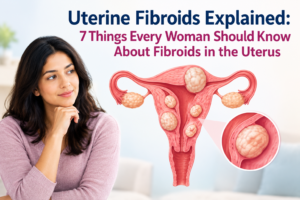
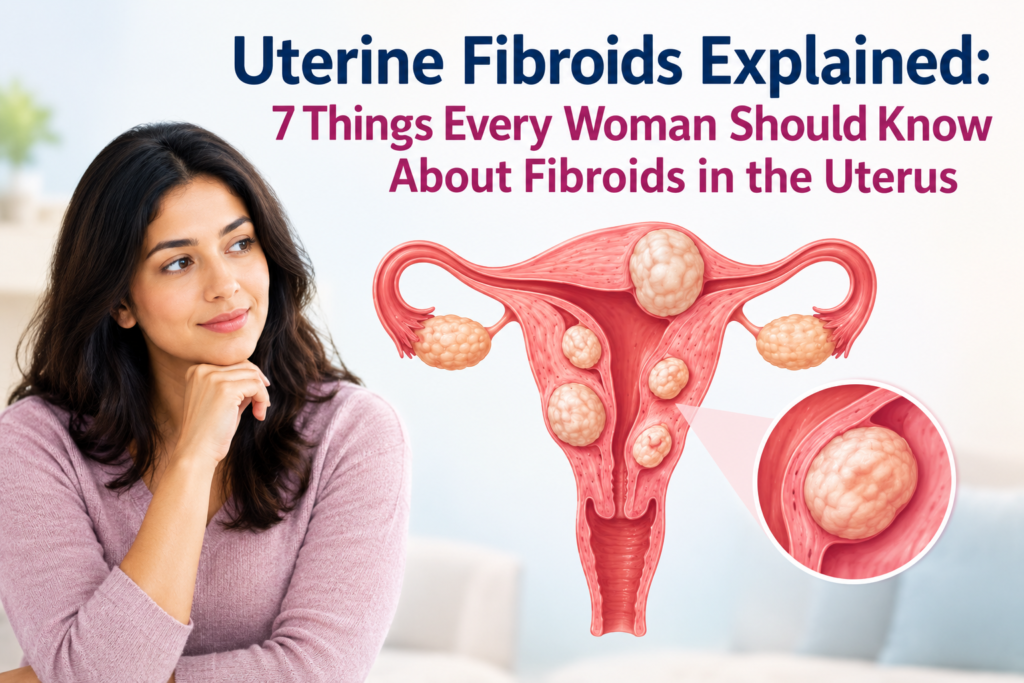
Doctors classify fibroids according to their location. This helps explain why two women with similar-sized fibroids may experience very different symptoms.
- Intramural fibroids
Intramural fibroids develop within the muscular wall of the uterus. Depending on their size and position, they may contribute to heavy periods, discomfort or enlargement of the uterus.
- Submucosal fibroids
Submucosal fibroids grow beneath the inner uterine lining and may project into the uterine cavity. They can be associated with heavy bleeding and may be relevant to fertility concerns.
- Subserosal fibroids
Subserosal fibroids grow towards the outside of the uterus. Larger growths may press against nearby organs and cause abdominal pressure or urinary symptoms.
- Pedunculated fibroids
Pedunculated fibroids attach to the uterus by a narrow stalk. Their location and attachment can influence the symptoms they cause and how they are managed.
Why does location matter?
The location, number and characteristics of fibroids help guide further assessment and treatment planning. A fibroid that distorts the uterine cavity may have different implications from one that grows towards the outer surface.
Fact 4: Hormones and Genetics Play a Role in Fibroid Growth
Why do fibroids develop? There is no single explanation that accounts for every case.
Research suggests that fibroid development involves a combination of hormonal influences, genetic changes and other biological factors.
The role of hormones
Oestrogen and progesterone influence uterine tissue and are involved in fibroid growth. Fibroids are commonly identified during the reproductive years, and many become smaller after menopause.
The role of genetics
Women with a family history of fibroids may have a greater likelihood of developing them. Genetic changes within individual fibroids can also influence their development.
Can fibroids be prevented naturally?
There is no guaranteed way to prevent fibroids. A balanced diet, regular physical activity and general health measures can support overall wellbeing, but no particular food, supplement or home remedy has been established as a reliable way to eliminate fibroids.
It is important not to blame yourself if you develop them.
Fact 5: Fibroids Do Not Always Prevent Pregnancy
A diagnosis of uterine fibroids does not automatically mean that a woman cannot conceive or have a successful pregnancy.
Their potential effect on fertility depends on factors such as their location, size, number and whether they distort the uterine cavity.
When might fibroids affect fertility?
Fibroids that distort the uterine cavity can be particularly relevant to implantation and reproductive outcomes. Other fibroids may have less impact.
Fibroids can also be associated with certain pregnancy complications, although the risks vary considerably between women.
Should fibroids be removed before trying to conceive?
Not necessarily.
The decision depends on the woman’s reproductive goals, symptoms, previous pregnancy history and the characteristics of the fibroids. Some women may be advised to proceed without surgery, while selected cases may benefit from treatment before attempting pregnancy.
The key takeaway: Fertility planning should consider the complete reproductive picture rather than the presence of a fibroid alone.
Fact 6: An Ultrasound Can Help Identify Fibroids, but Treatment Depends on the Findings
A pelvic ultrasound is commonly used to detect uterine fibroids and assess their size, number and location.
Depending on the symptoms and findings, additional investigations may be considered.
Investigation | Why it may be used |
Medical history and examination | Understand symptoms and assess the uterus |
Pelvic ultrasound | Identify fibroids and examine the uterus |
Complete blood count | Check for anaemia associated with heavy bleeding |
MRI | Provide more detailed information in selected cases |
Hysteroscopy | Examine the uterine cavity when indicated |
Not every woman requires all these investigations. The appropriate evaluation depends on the symptoms, examination and initial findings.
What happens after fibroids are detected?
The next step is to determine whether the fibroids are causing symptoms and whether any intervention is appropriate.
A small, symptom-free fibroid may need only observation. A fibroid associated with substantial bleeding, pressure or reproductive concerns may warrant further discussion of management options.
The ultrasound report is an important starting point, but it should be interpreted in the context of the woman’s overall clinical situation.
Fact 7: Fibroid Treatment Can Range From Monitoring to Surgery
Treatment depends on the individual’s symptoms, reproductive plans, fibroid characteristics and overall health.
There is no single treatment that is right for every woman.
Option 1: Observation
Monitoring may be appropriate when fibroids are not causing significant symptoms. Follow-up is tailored to the individual.
Option 2: Medication
Selected medicines may help control heavy bleeding or other symptoms. Their effects and suitability depend on the clinical situation.
Option 3: Hysteroscopic treatment
Selected fibroids projecting into the uterine cavity may be removed using a hysteroscopic approach.
Option 4: Myomectomy
Myomectomy removes fibroids while preserving the uterus. Depending on the case, it may be performed laparoscopically or through an open surgical approach.
Option 5: Other procedures or hysterectomy
Uterine artery embolisation may be suitable for selected patients. Hysterectomy may be considered for women with significant symptoms who do not wish to retain their uterus.
Myomectomy or hysterectomy: How are they different?
Feature | Myomectomy | Hysterectomy |
What is removed? | Fibroids | Uterus |
Is the uterus preserved? | Yes | No |
Is future pregnancy possible? | Potentially, depending on the individual circumstances | No |
Can uterine fibroids develop again? | Yes | No, because the uterus is removed |
These procedures have different implications and are not interchangeable. The appropriate option depends on the individual’s health, symptoms and preferences.
When Should You Seek a Gynaecological Assessment?
Consider arranging an assessment if you notice:
- Periods that are repeatedly heavy or prolonged.
- Increasing menstrual discomfort.
- Persistent lower abdominal pressure or fullness.
- Frequent urination alongside pelvic symptoms.
- Difficulty conceiving when fibroids are present.
- Ongoing fatigue, dizziness or breathlessness associated with heavy bleeding.
Seek urgent medical attention if extremely heavy bleeding is accompanied by fainting, severe weakness, marked dizziness, breathlessness or severe pelvic pain.
Bleeding after menopause also requires prompt assessment, even if it is light.
Uterine Fibroid Care in Whitefield and Bengaluru
Women searching for information about uterine fibroids in Whitefield, ITPL, Hoodi, Marathahalli and other parts of Bengaluru may be looking for answers about menstrual changes, ultrasound findings or possible treatment options.
When researching gynaecological care, it can be helpful to understand whether an assessment includes a review of menstrual symptoms, the location of fibroids, their potential effect on fertility and a discussion of the available management approaches.
For women considering an appointment with a gynaecologist in Whitefield, Bangalore, useful questions include:
- What type of fibroid has been identified?
- Is it likely to explain my symptoms?
- Is observation sufficient?
- Could it affect future pregnancy?
- What are the benefits and limitations of the treatment options?
- What follow-up may be required?
These questions can help make the consultation more informative and support a clearer understanding of the condition.
Frequently Asked Questions About Uterine Fibroids
- Are uterine fibroids dangerous?
Most fibroids are benign and do not cause serious problems. However, fibroids associated with significant bleeding, anaemia, pressure symptoms or reproductive concerns may need further evaluation.
- Can a fibroid disappear without treatment?
Some fibroids remain stable, and many shrink after menopause. However, spontaneous shrinkage varies, and fibroids do not always disappear completely.
- Can a small fibroid cause heavy periods?
Yes. A small fibroid that projects into the uterine cavity may contribute to heavy bleeding. Location can be as important as size.
- Does every fibroid require surgery?
No. Many women can be monitored without immediate treatment. Medication or a procedure may be considered when symptoms or other clinical factors justify it.
- Can fibroids affect pregnancy?
Some fibroids have little effect on pregnancy, while others may be associated with fertility difficulties or pregnancy complications. Their location and characteristics help determine their relevance.
- Can fibroids grow after menopause?
Fibroids commonly shrink after menopause, but changes vary. A new or enlarging pelvic mass or any postmenopausal bleeding requires appropriate evaluation rather than being automatically attributed to fibroids.
- Is laparoscopic myomectomy suitable for all fibroids?
No. The suitability of laparoscopic surgery depends on the number, size, location and characteristics of the fibroids and the individual’s health.
- Can fibroids return after myomectomy?
Yes. New fibroids may develop or existing fibroids may grow after myomectomy. Follow-up depends on the individual circumstances.
- Can fibroids cause anaemia?
Yes. Repeated heavy menstrual bleeding associated with fibroids can lead to iron deficiency and anaemia. A blood test can help assess for anaemia.
- Can lifestyle changes shrink uterine fibroids?
There is no reliable evidence that a specific diet, exercise routine or supplement can eliminate fibroids. Healthy habits support general wellbeing, but established fibroids may require observation, medical management or a procedure depending on symptoms and clinical findings.
- Which scan is used to detect uterine fibroids?
Pelvic ultrasound is commonly used. MRI may be considered when more detailed information is needed.
- What should I do if I have fibroids but no symptoms?
Asymptomatic fibroids often do not require immediate treatment. The need for follow-up depends on the clinical findings, medical history and any changes in symptoms.
Final Takeaway
Uterine fibroids are common, and their effects vary from woman to woman. Some cause no symptoms, while others contribute to heavy periods, pelvic pressure or fertility-related concerns.
The most useful starting point is to understand the fibroid’s location and characteristics, assess whether it explains the symptoms and consider the available management options in the context of individual needs.
For women researching uterine fibroids in Bengaluru, reliable information can help clarify the condition and prepare them for an informed discussion about their gynaecological health.